At Texworld and Avantex Paris 2026, one topic appeared in conversations with fashion brands and manufacturers more than almost any other: artificial intelligence.
The enthusiasm was clear. Businesses wanted to understand how AI could support product development, sourcing, compliance, sustainability and supply-chain operations.
But another pattern was equally clear. Many businesses had product information scattered across spreadsheets, PDFs, email conversations, tech packs, supplier portals and disconnected internal systems. They understood what tools such as ChatGPT and Gemini could do, but they were less certain about how to implement AI within their actual business processes.
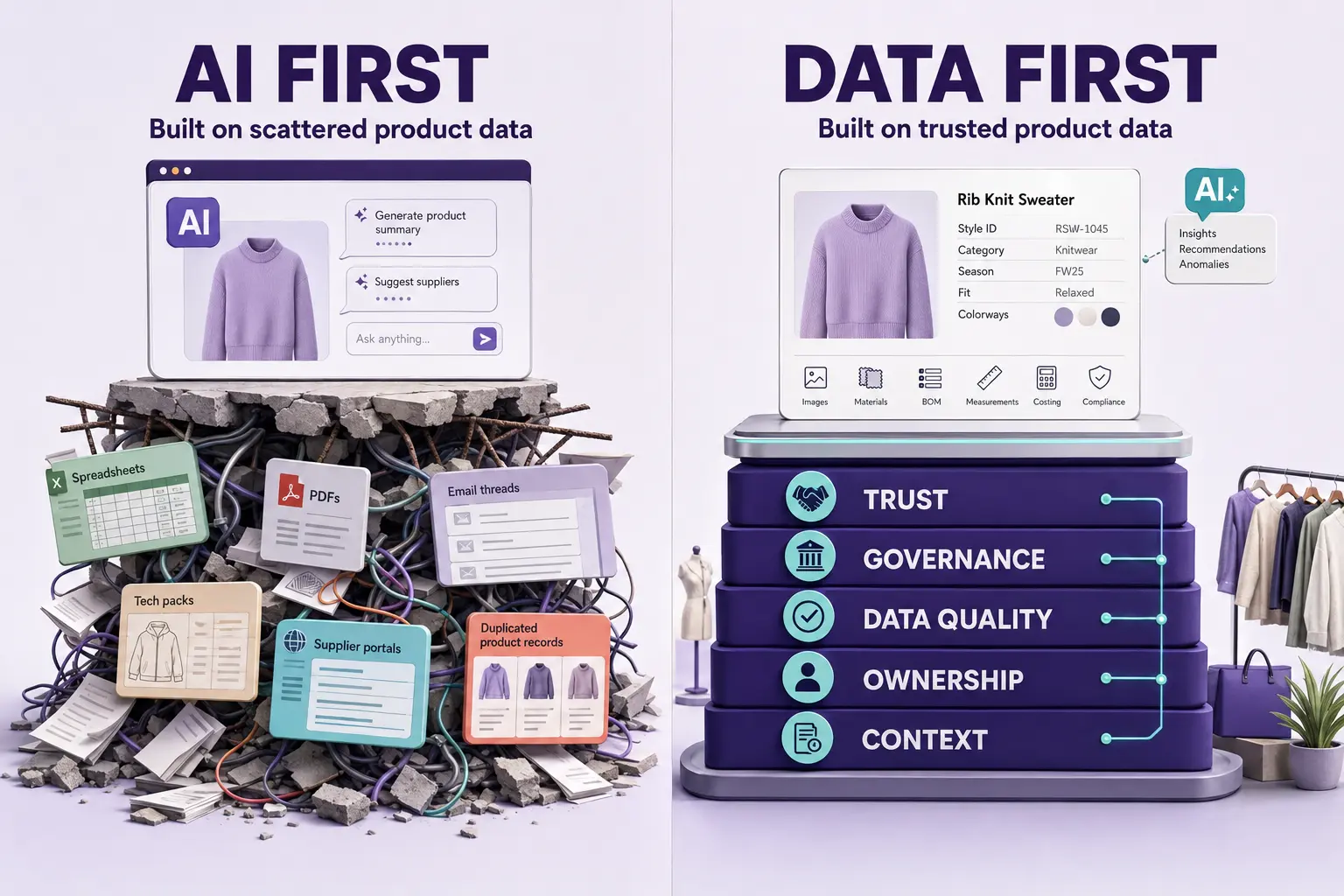
AI is easy to access. Reliable business AI is much harder to build.
A general AI model can produce an answer from a prompt. An operational AI system must understand which product is being discussed, which data is current, which supplier provided it, which evidence supports it and whether that information has been approved.
Without structured product data, AI cannot reliably make those distinctions.
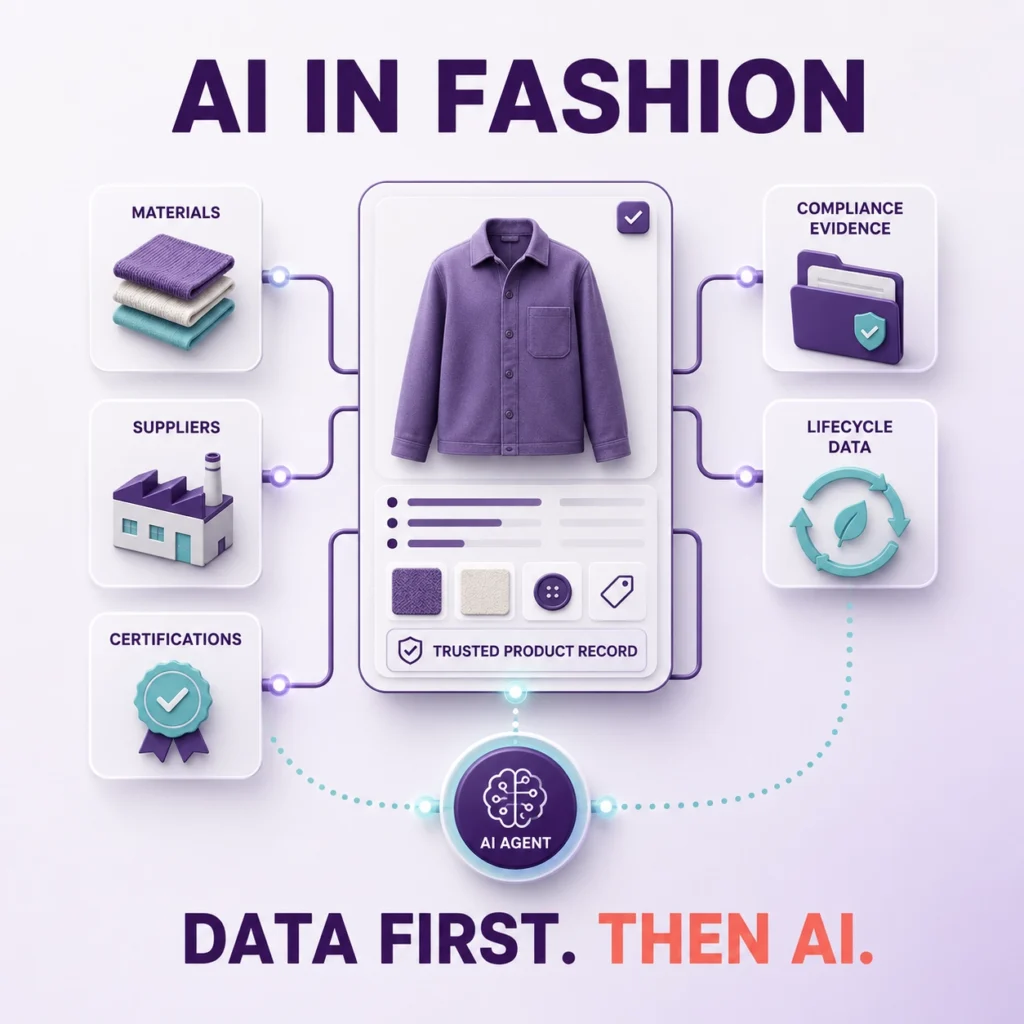
AI in fashion is moving beyond content generation, forecasting and virtual experiences. Fashion businesses are beginning to explore AI agents that can support sourcing, product data management, compliance and supply-chain operations.
However, AI agents require accurate, connected and governed business data. If product specifications, materials, supplier records, certifications and compliance evidence remain scattered across different systems, AI may generate an answer, but the business cannot confidently rely on it.
The correct sequence:
AI is not the starting point. Data is.
Why AI became a major topic at Texworld and Avantex Paris
AI was not discussed as a distant technology at Texworld and Avantex Paris 2026. Brands and manufacturers were actively considering how it could be incorporated into daily operations. The questions were practical:
- Can AI reduce repetitive product-data work?
- Can it help collect information from suppliers?
- Can it identify missing compliance evidence?
- Can it prepare reports and declarations?
- Can it help businesses manage new regulatory requirements?
- Can AI make product development and sourcing faster?
These are valuable use cases. But they require more than access to a generative AI interface. A fashion business may have thousands of products, with each product connected to different colours, sizes, materials, components, suppliers, factories, certifications, packaging formats and target markets. AI cannot work reliably across that complexity unless those relationships are available in a structured and understandable format.
The European Commission similarly identifies access to high-quality data as essential for developing and applying advanced AI. Its wider approach also emphasises trustworthy AI, data governance and responsible implementation.
For fashion businesses, this means AI readiness begins long before the first AI agent is activated.
Using ChatGPT is not the same as implementing AI in a business
ChatGPT, Gemini and other general-purpose models are powerful tools. They can help teams draft content, summarise documents, explore ideas and analyse information supplied through a prompt. However, access to an AI assistant does not automatically create an operational AI system.
By default, a general AI model does not know:
Consider a simple question:
"Is this product ready to be placed on the EU market?"
To answer reliably, an AI system may need to review the product classification, bill of materials, supplier records, test reports, declarations, labelling, instructions, applicable regulations and approval status. If that information is incomplete or spread across disconnected locations, the AI does not have enough context to provide a dependable answer.
A useful distinction:
Both can be useful. But they solve different problems.
Why disconnected fashion product data limits AI
The problem is not usually that fashion businesses have no data. Most have a significant amount of it. The problem is that the data was created for different teams, at different times and for different purposes.
A design team may manage specifications in tech packs. Sourcing may track suppliers through spreadsheets and email. Compliance may store certificates in shared folders. Sustainability teams may request separate material and facility information. E-commerce teams may maintain another version of the product description. Each team may be working with legitimate information, but there is no guarantee that the records are aligned.
Multiple product identifiers
The same product may use one code in the design system, another in the ERP, another with the supplier and another on the e-commerce platform. AI cannot connect those records confidently without a documented relationship.
Conflicting versions
Files with names such as FINAL, FINAL-V2 and LATEST-APPROVED may make sense to the person who created them. They do not provide reliable version control for an automated system.
Information trapped inside documents
Tech packs, test reports, certificates and supplier forms often lock valuable data inside PDFs, images or free-text fields. AI can help extract it, but the result must still be mapped to the correct product, field and evidence source.
Missing relationships
Knowing that a certificate exists is not enough. The business must know which products and variants it covers, which supplier is involved, when it expires and what other documents depend on it.
Unclear ownership
If nobody is responsible for reviewing or approving a field, the business cannot know whether it is ready for automation or external publication.
Inconsistent terminology
One supplier may describe a material differently from another. Without standardisation, AI may treat related information as separate, or combine information that should remain distinct.
What structured product data actually means
Structured product data is not simply a tidy spreadsheet. It means information is organised in a consistent model that machines and people can understand. For fashion businesses, a structured product record may connect:
The relationships between these records are as important as the individual fields. For example, an AI agent should not simply find a certificate in a folder. It should understand:
That connected context turns stored information into usable product intelligence.
AI needs context, lineage, ownership and governance
Data quality is often treated as a question of whether a field is complete. For operational AI, completeness is only one part of the picture. Reliable AI implementation in fashion requires several layers.
How AI agents can support fashion businesses
Once product and supply-chain data is structured, AI agents can support practical workflows across the fashion business. The value does not come from adding AI everywhere. It comes from selecting controlled, repetitive and data-heavy processes where the required context already exists.
Product data capture and classification
AI agents can help extract information from supplier documents, specifications and technical files, mapping it into defined product fields rather than leaving it trapped inside individual documents. Human review should remain part of the process, especially for compliance-sensitive information.
Supplier data collection
Instead of teams manually reviewing multiple spreadsheets and email threads, an AI-supported workflow can help identify missing information, prepare supplier requests and monitor outstanding actions. The agent needs context about the product, supplier, required fields and due dates, without that foundation, follow-ups become generic and hard to control.
Compliance gap detection
An AI agent can compare the information available for a product with an approved requirement or checklist. It may identify:
- Missing certificates
- Expired documents
- Incomplete test evidence
- Conflicting material information
- Unapproved claims
- Products without the required instructions
- Variants not clearly mapped to supporting documentation
The AI does not replace the compliance professional. It helps the professional find the areas that require attention.
Product content and document generation
Approved product data can be used to prepare product descriptions, technical summaries, declarations, supplier instructions and other controlled outputs. This is safer than asking a general model to generate content from incomplete background information, because the output begins with an approved product record.
AI in fashion supply-chain monitoring
AI agents can help monitor changes across products and suppliers. A change in factory, material, component or certificate can trigger a review of the related products and documents. Relationships become critical here, the system must understand which records are affected before it can recommend an action.
Digital Product Passport preparation
A Digital Product Passport is just the tip of the iceberg. The QR code and mobile passport are the visible outcome; underneath sit product records, materials, suppliers, certifications, evidence, data permissions and operating processes. The same structured product-data foundation required for a reliable DPP also creates a stronger foundation for AI. Learn more in our practical Digital Product Passport guide for fashion.
Reporting and audit preparation
When products, documents and suppliers are connected, AI can help assemble information for internal reviews, customer requests, sustainability reporting and regulatory audits. Teams can spend less time searching for files and more time reviewing whether the evidence is correct.
Product Relationship Management creates the context AI needs
Most business systems were created around a specific function. ERP systems focus on transactions and resources. CRM systems manage customer relationships. PLM systems support product development. PIM systems manage product information for distribution. These systems remain valuable, but AI often needs context that crosses their boundaries.
A CRM keeps the customer at the centre. A Product Relationship Management platform keeps the product at the centre and manages all relationships around it, including relationships between:
This connected product context gives AI agents a controlled environment in which to operate. Instead of asking an AI model to search across disconnected information and guess which record is correct, teams can allow agents to work from one reliable product record with defined relationships, permissions and approval statuses.
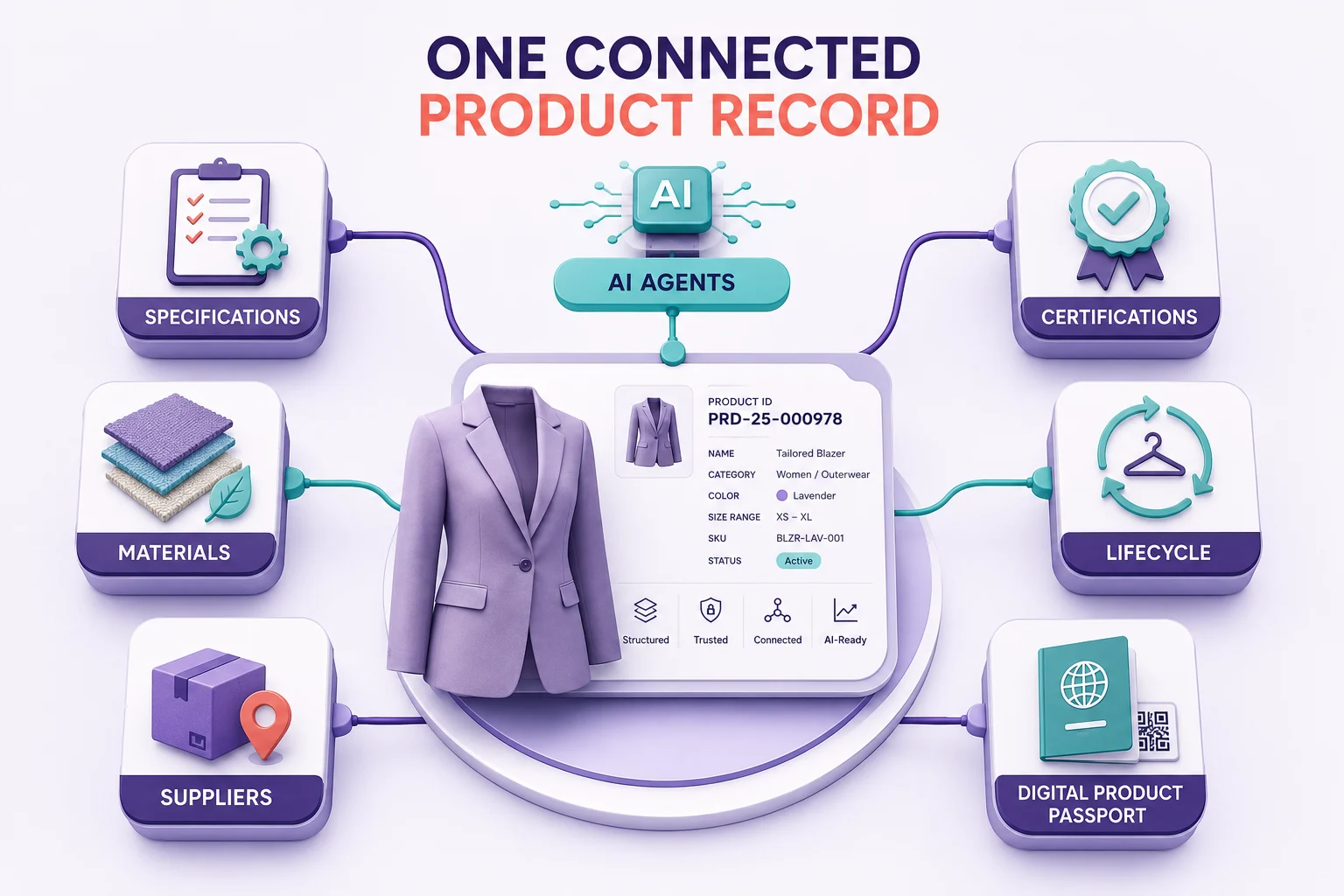
The correct sequence for AI implementation in fashion
Starting with an AI tool and searching for a problem afterwards often creates isolated experiments. A stronger implementation sequence begins with a specific operational outcome.
Select one business problem
Choose a process that is repetitive, measurable and dependent on product data: checking supplier submissions for missing fields, classifying product documents, monitoring certificate expiry, preparing approved product descriptions, identifying incomplete DPP records, or creating compliance-review summaries. Avoid beginning with a broad objective such as "implement AI across the company."
Map the required data
Identify every field, document, relationship and approval needed to complete the process correctly. This reveals whether the business has the required data and where the gaps exist.
Establish the product record
Connect the data to one controlled product identity. The record should make it clear which variants, suppliers, components and documents are involved.
Standardise and validate
Agree on field formats, terminology, required evidence and acceptance rules. This is essential when information is received from multiple suppliers or internal teams.
Assign ownership and permissions
Define who contributes, reviews, approves and publishes the information. AI agents should operate within these rules rather than bypassing them.
Introduce one controlled AI agent
Start with a narrow workflow and maintain human review. Measure whether the agent reduces manual work, improves completeness or shortens response times.
Expand using the same data foundation
Once the first workflow is stable, the same structured product data can support additional agents and processes. This is more scalable than building a separate dataset and integration for every AI experiment.
A practical AI-readiness checklist for fashion businesses
Before implementing AI agents in fashion operations, ask:
If the answer to several of these questions is no, the immediate priority is not selecting another AI tool. It is improving the product-data foundation.
The Seamless Source approach to AI in fashion
Seamless Source structures product, supplier, compliance and lifecycle information around one connected product record. Our Product Relationship Management platform brings together PIM, PLM, Digital Product Passports, compliance workflows, supply-chain traceability and AI agents.
The objective is not to introduce AI as a disconnected feature. The objective is to give AI agents the product context required to support meaningful work. Depending on the workflow, this can include:
- Organising and classifying product information
- Identifying missing data or evidence
- Supporting supplier communication
- Monitoring compliance records
- Preparing controlled documents and reports
- Structuring data for Digital Product Passports
- Keeping approved information aligned across teams and channels
AI remains part of a governed process. Teams retain visibility over the data, evidence and decisions behind each output. See how Seamless Source connects product data and AI agents.
AI in fashion should begin with the product
The next stage of AI in the fashion industry will not be defined only by which business has access to the most advanced model. The models are becoming widely available. The greater advantage will come from having reliable business context: structured product data, connected supplier relationships, controlled evidence and clear operating processes.
Fashion businesses do not need to solve every data problem before experimenting with AI. But they should begin with a clearly defined workflow and understand the data required to support it. Otherwise, AI risks becoming another disconnected layer placed on top of already fragmented systems.
Structure the data. Connect the relationships. Establish trust. Then activate AI.
That is how fashion businesses can move from experimenting with AI to using it across real product and supply-chain operations.
Ready to build the data foundation for AI?
Seamless Source helps fashion businesses organise product, supplier and compliance data into one connected system of record, creating the foundation for AI agents, Digital Product Passports and scalable product operations.
Book a conversation with Seamless SourceFrequently asked questions about AI in fashion
How is AI used in fashion?
AI in fashion can support product-data extraction, demand forecasting, design assistance, supplier communication, compliance checks, product content, Digital Product Passports and supply-chain analysis. The reliability of each use case depends on the quality and context of the available data.
Why is structured product data important for AI?
Structured product data helps AI understand what each piece of information represents, which product it belongs to, where it came from and whether it has been approved. Without that structure, AI may use incomplete, conflicting or outdated information.
What are AI agents in fashion?
AI agents in fashion are systems designed to support specific workflows using product, supplier or operational data. Unlike a general chatbot, an AI agent can work within defined processes, permissions and approval rules.
Can ChatGPT implement AI across a fashion business?
ChatGPT can support individual tasks such as drafting, summarisation and analysis. Business-wide AI implementation requires connections to internal data, defined workflows, permissions, governance and human oversight.
What is the connection between AI and Digital Product Passports?
AI and Digital Product Passports both depend on structured product, material, supplier and compliance data. AI can help collect, review and organise DPP information, while the DPP provides a practical output for approved product data.
Where should a fashion business begin with AI?
Start with one measurable operational problem. Map the data and approvals required, organise that information around the correct products and introduce a controlled AI agent with human review.